

AI casting: one actor, every shot
How to generate a pool of faces, lock one as a character sheet, and carry that same person across every setup in a film. The prompt that works, the three clauses that break it, and why.
The hard part of AI film is not making one good shot. It is making the second shot with the same person in it.
This is the process behind a twelve-setup film where every frame holds the same actor. You generate a pool of faces, pick one, and everything after that refers back to her.
Build the pool
Describe the room, not the woman. A casting session is different people photographed under identical conditions, so the prompt locks the conditions and leaves the person open.
Vertical phone photo, woman in her early twenties at her desk, shot straight on at eye level on a small desk stand. Chest up, head in lower half of frame, wide band of warm off white wall above. Mouth closed, looking directly into lens. Oatmeal ribbed knit top. Unretouched skin, visible pores, flat frontal light. Soft frontal light from phone plus a lamp just off camera at eye level; light falls off quickly, desk and background noticeably darker, small shelf lamp prevents black shadows. Behind her: warm off white wall, half closed laptop, ceramic mug, small framed print, open notebook with pen, charging cable trailing off desk edge. Warm consistent tone, shadows lifted and slightly milky. Desk and wall gently out of focus. Slight oversharpening where lit shoulder meets darker wall; noise reduction smoothing visible in dim background. --no retouched skin, smooth skin, airbrushed, flawless skin, model, glamour, open mouth, mid-speech, talking, letterbox, black bars, borders, studio lighting, softbox, professional lighting, stock photo, advertisement --ar 9:16 --raw --stylize 200 --hd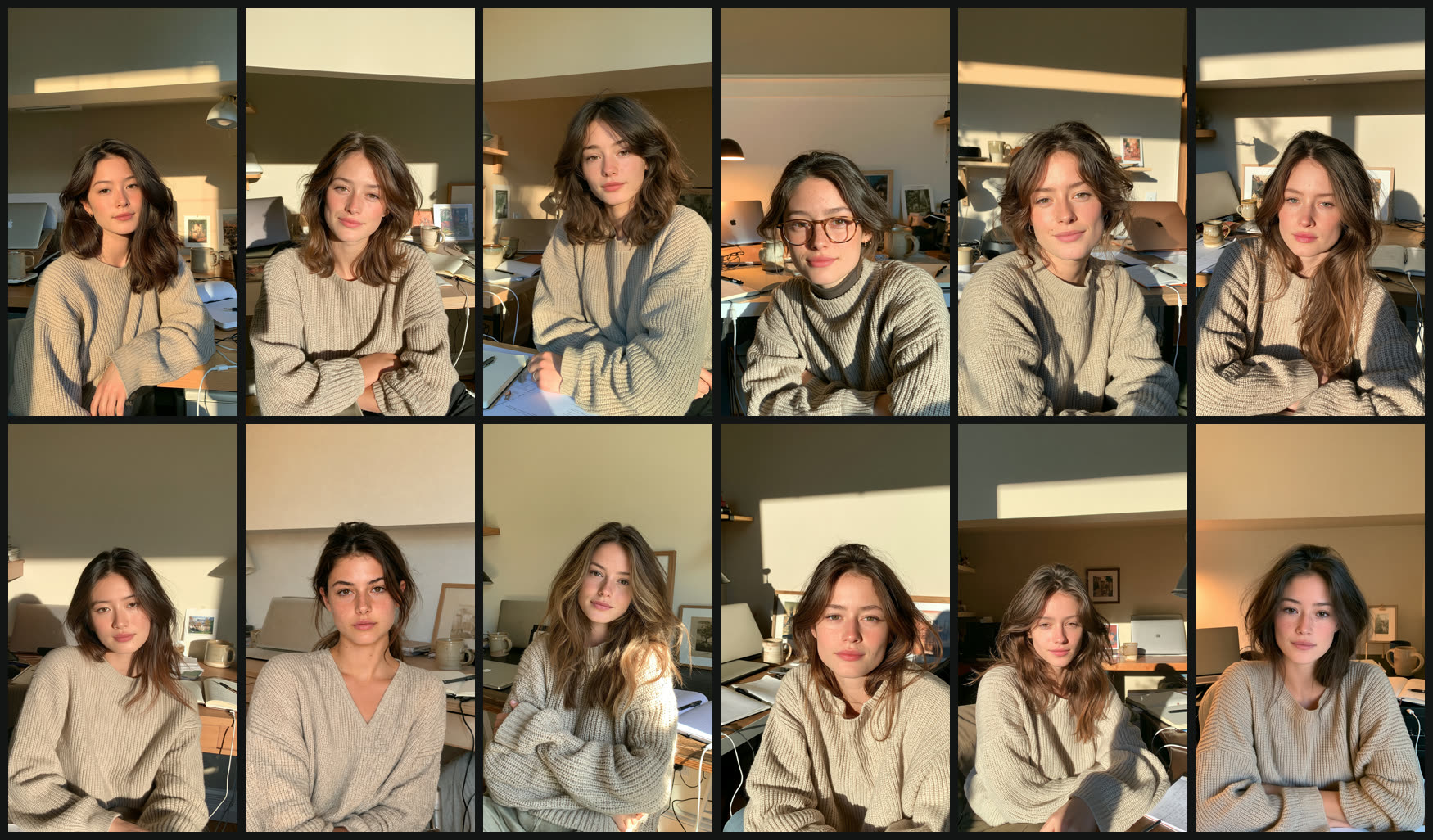
The one that got cast is in that grid. Nothing about the frame tells you which.
The subject is five words: “woman in her early twenties.” No heritage, no hair colour, no eye colour, no jawline, no beauty standard. Everything else is room, camera and light.
Pin the version before you run it. That prompt carries no --v, so it took whatever the default was
that day and will not reproduce as written.
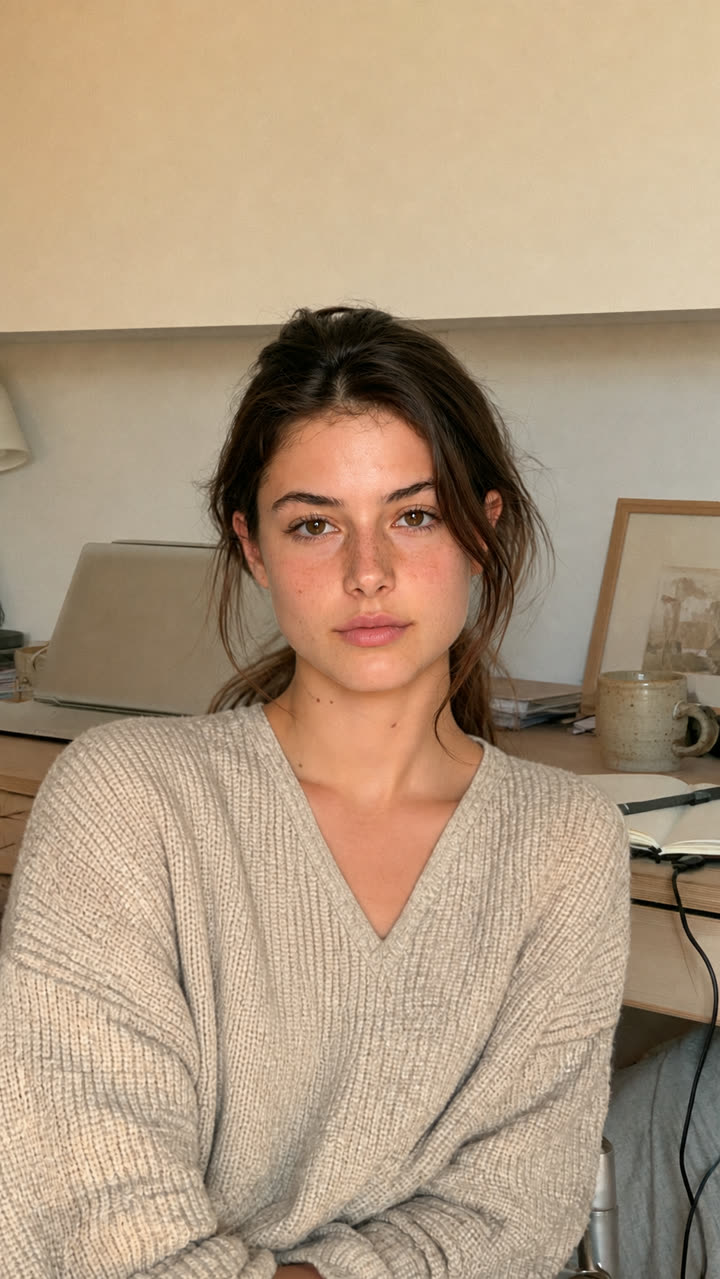
Pick the keeper
Choose one face. Not the most attractive one, the one you can watch for the length of a film.
Lock the character sheet
Take the keeper into ChatGPT and ask for three angles.
Make a character sheet of this woman from Image1 with three equal panels of her looking to the left, straight ahead, and to the right on a plain light grey background. Make it a closeup from the neck and shoulders up. Use the face and identity of the woman in Image1 with a plain grey sweatshirt.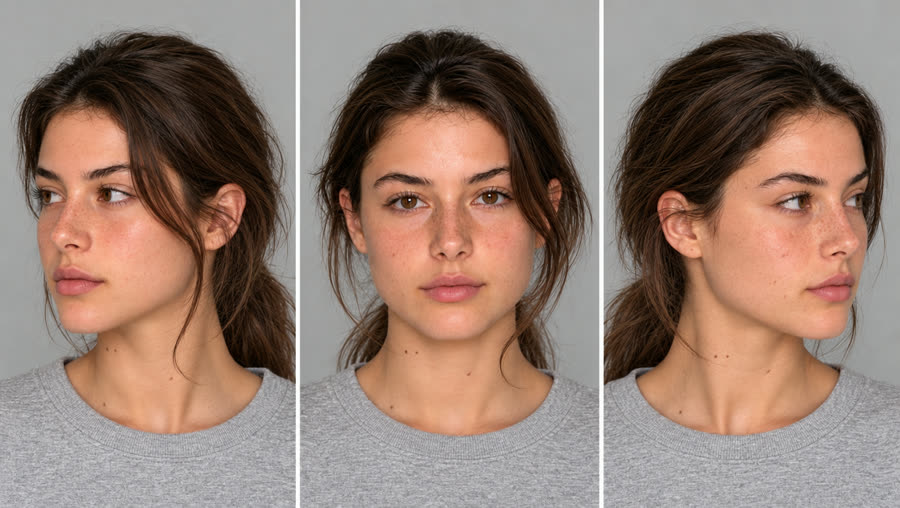
Name the three angles. An earlier sheet asked for a turn without naming directions and returned panels two and three about five degrees apart.
Crop tight and strip the background. Every pixel spent on a room is a pixel not spent on the face.
From here you stop describing her and start handing over an image. A description drifts between runs. An image does not.
Populate the shots
Build every setup the film needs, without worrying who is in them. A kitchen, a bar, a park path. Finished frames containing the wrong person.
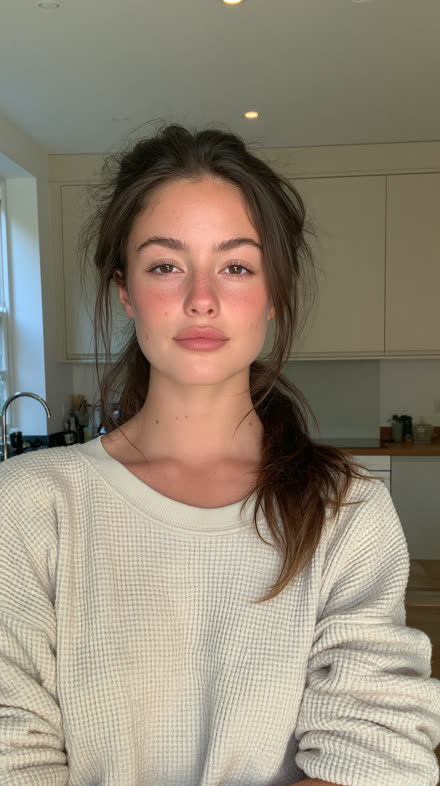
Vertical phone photo of a 22 year old woman standing at the counter of a residential kitchen in the daytime, shot on a phone propped on the counter a few feet in front of her at eye level, straight on and locked level. Standing upright and not leaning. Framed close: her head and face fill the upper two thirds of the frame and the bottom edge cuts straight across her chest just below the collarbone. Nothing below her chest is in frame. Clean jawline, well proportioned features, mouth closed and not smiling, expression level and neutral. Long dark hair tied back loosely with strands escaping. Clear skin with visible pores, fine peach fuzz along jaw, unretouched texture. Cream waffle knit long sleeve top with the sleeves pushed up. Looking straight down the lens. Bright flat midday light: strong cool daylight from a window off to one side filling the whole room, plus a warm overhead ceiling light, the two colours not matching where they meet. The room is evenly and brightly lit with no deep shadows, nothing golden and nothing moody; no other light source. Behind her: a plain kitchen that has been completely cleared. Bare empty countertops with nothing standing on them anywhere, plain flat cupboard fronts, a blank wall. No jars, no packets, no bottles, no appliances, no kettle, no coffee maker, no dishes, no tea towels, no paper, no fruit, no plants, no ornaments. Every surface empty. Almost too tidy, like a kitchen nobody has cooked in yet. Warm consistent tone throughout; shadows lifted and slightly milky. Soft background falloff, the far side of the kitchen gently out of focus. Slight oversharpening where lit shoulder meets darker cupboard; dim background shows noise reduction smoothing. --no clutter, cluttered surfaces, mess, messy, smile, smiling, smirk, arms, hands, forearms, retouched skin, smooth skin, airbrushed, flawless skin, open mouth, mid-speech, talking, letterbox, black bars, borders, studio lighting, softbox, professional lighting, stock photo, advertisement --ar 9:16 --raw --stylize 300Most of that prompt is spent emptying the room. Bare counters, no jars, no kettle, no fruit. A plate is a room the swap has to survive, and clutter near her face breaks first.
Name a colour and a brightness together. That plate took three rolls because the first two said cool and flat without saying bright, and the model filled in golden hour twice.
Cast the plates
Two images in, one out. Image1 is the plate, carrying room, light and framing. Image2 is the
sheet, carrying the face. The slot order does not show in the output, so fix it once and keep it.
Return a 9:16 image just like @Image1 , but switch the character out for the woman in @Image2 . @Image2 is a three-view reference sheet of one person, not three people. Keep the first image's room, wardrobe, light, framing and pose exactly as they are.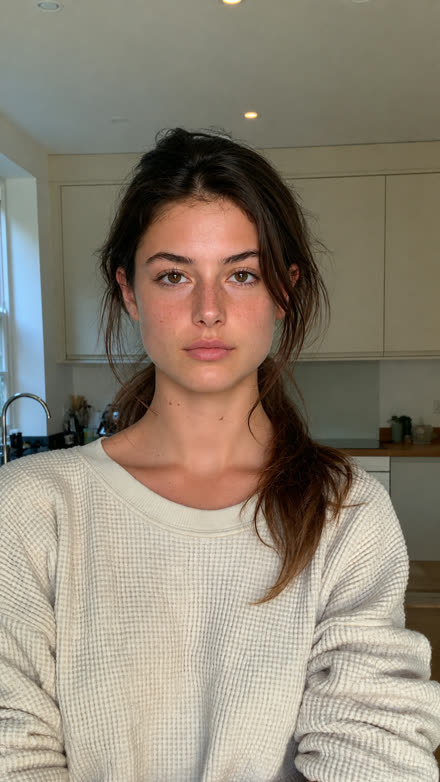
Say the sheet is one person. Three panels is three faces on one canvas, and the model will blend them otherwise.
The closing sentence does the real work. Naming the room, wardrobe, light, framing and pose as things to keep turns a re-render into a swap.
Pick three or four identity markers first and check them every time. Here it was freckles, the moles on her neck, the heavier brow, the closed mouth.
Use GPT Image, not Nano Banana. Run on the same transfer, Nano Banana returned the better photograph and the worse composite: lost freckles, smoothed skin, thinner brows, a slight smile, moved arms. It re-rendered the scene where GPT Image swapped the face. The cost is resolution, and resolution is recoverable with an upscale while identity is not.
Shoot
Feed each cast still into Seedance as the first frame.
Check three things on every take. Does the face hold. Do the mouth shapes stay clean through the talking frames. Does the camera stay put, which you test by comparing fixed objects at the start, middle and end rather than by watching once.
Then watch the hands. A held object reads as someone doing something. A hand reaching toward the lens reads as an advertisement.
What breaks it
Three clauses were pinning the face in prompts meant to leave it open. Each looked like staging.
| The clause | What it was doing |
|---|---|
clean jawline, well proportioned features | Stating a beauty standard, so the model converged on its own ideal |
smile sitting slightly higher on one side | Naming a bounded detail, which describes one person |
distinct ring catchlight in each iris | Putting an identical artifact in every eye |
A pin is anything the model can only satisfy one way. An age, a heritage, a hair colour, a named feature, a beauty standard. Each one halves the pool.
--chaos does not fix it. It varies the frame rather than the face, so the room drifts before the
casting does.
Vagueness alone is not enough either. An earlier batch kept the sheet’s full subject description and returned eight near-identical faces. That description works for a sheet, where one face is the point.
The rule worth keeping
Vague the person. Keep the room.
Everything that makes a pool read as one session lives in the camera, the light, the desk and the wall. None of it lives in her face, so her face is the only thing that should float.
The same control runs both ways. A small mole below the left corner of the mouth describes exactly one person, which is what you want when locking an identity and exactly what you remove when opening a call.