

Kaiju in the Neon Rain
How to prompt a monster that still looks great on a phone. One still, one prompt, Midjourney.
The prompt
Copy it, run it, change whatever you want. No signup.
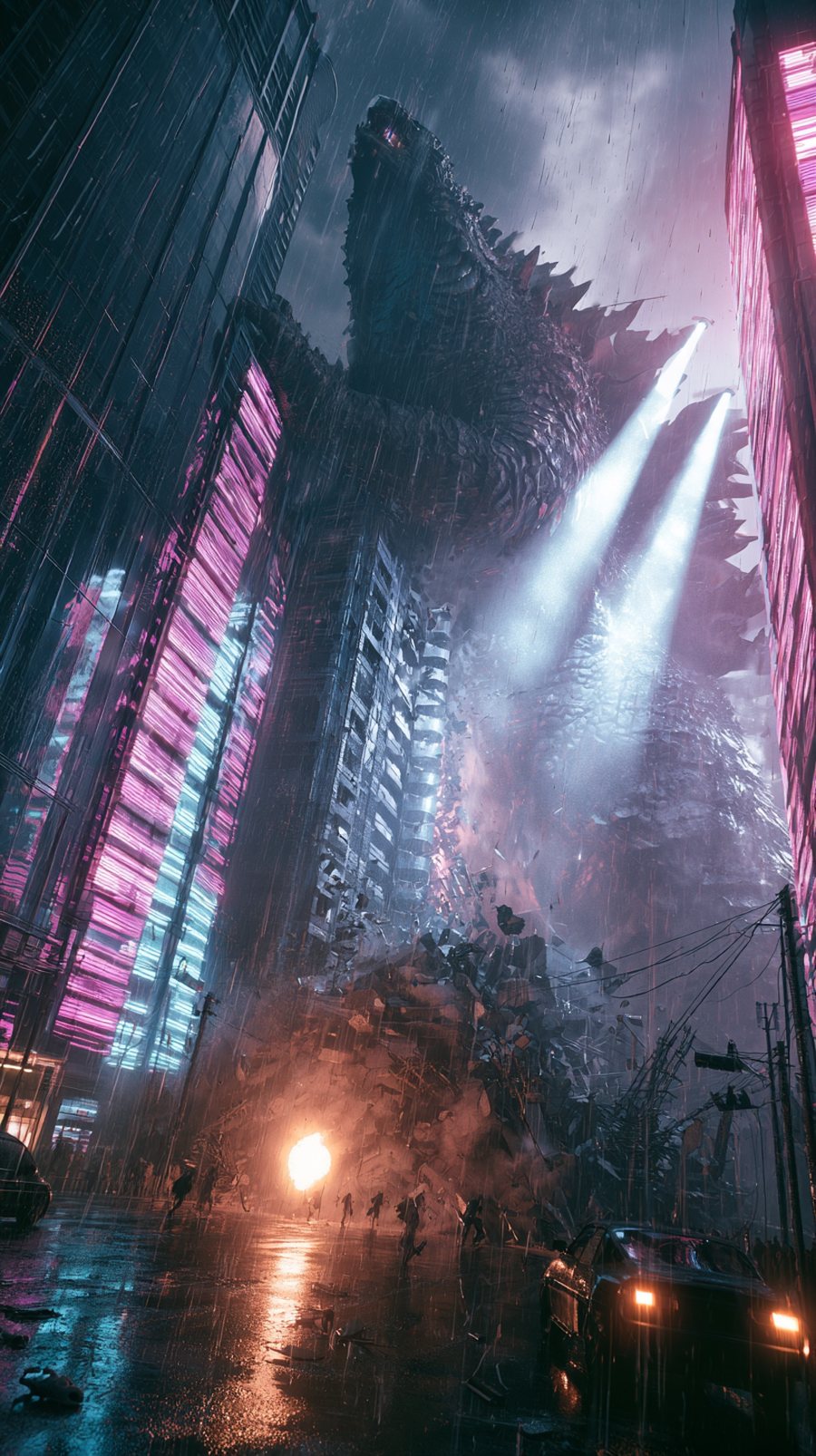
Kaiju action still, night, heavy rain, steep street level upward angle, 18mm handheld, f/2.8, deep focus, rain beading on lens. Narrow downtown canyon: curtain wall glass and stacked neon signage in magenta and cyan climbing both sides, color flooding wet black asphalt below. A colossal armored creature fills the upper two thirds, driving one forelimb through a mid rise tower, wet slate grey hide, thick overlapping barnacle crusted plates, rain sheeting off in ropes, head cropped by frame edge. Two volumetric helicopter searchlight beams rake its flank from off right, blowing wet plating to hard white. Magnesium flare burns on the street. Shattered glass, concrete, and rebar fall toward camera in motion blur. Tiny fleeing figures and one abandoned car with blinking amber hazards below. Sky full of rain streaks, smoke, and searchlight haze. Saturated magenta/cyan neon, desaturated grey concrete, tungsten balanced stock pushed one stop, heavy grain. Edge to edge, no borders. --no letterbox, black bars, borders, matte, split screen, diptych, triptych, collage, grid --ar 9:16 --raw
Why it works
A monster shot usually fails on a phone for one reason. The creature reads as a dark shape in a small frame, and nothing tells the eye how big it is. Every line below is there to fix that.
The lens comes first. steep street level upward angle, 18mm puts the camera on the ground and makes the buildings lean in toward the top of the frame. Anything above a wide lens set that low looks like it towers. Start every scale shot by deciding where the camera stands.
The canyon gives the creature a corridor. neon signage in magenta and cyan climbing both sides builds two walls of color with a gap between them. The creature fills the gap, so the eye reads it against the walls instead of against an empty sky.
The size is stated as a share of the frame. fills the upper two thirds tells the model how much of the picture belongs to the creature. A word like “colossal” says it is big. A share of the frame says how big it is in this picture.
The light comes from outside the frame. searchlight beams rake its flank from off right gives the beams a count, a kind and a side. This line landed in all four renders, with two beams, volumetric, entering from the upper right every time. Light described as an object in the scene, with a number and an entry side, holds better than a general lighting direction.
Something small gives the eye a ruler. Tiny fleeing figures and one abandoned car with blinking amber hazards are what make the creature huge. Scale is relative, so the picture needs an object the viewer already knows the size of. This instruction has worked in every set it has been tried in.
The film stock finishes it. tungsten balanced stock pushed one stop, heavy grain sets the color temperature and the texture. It is the line that makes the frame look photographed.
Before you run it
Pick one brightest thing. This prompt names three: the searchlights, the magnesium flare and the neon. In two of the four renders the flare won and washed the whole frame pink. If the neon palette matters to you, rank the lights in the prompt. Say the flare stays dimmer than the searchlight beams, or cut the flare.
Framing distance is the weakest instruction. head cropped by frame edge did not land in any of the four renders. Write it if you want it, but expect to crop the head yourself.
To make it yours, change the creature and keep the rest. The lens, the canyon, the share of the frame, the off-screen light and the ruler work for any giant subject.